Tag Archives: Electronics Manufacturing

How Prototype PCB Assembly Accelerates Product Development

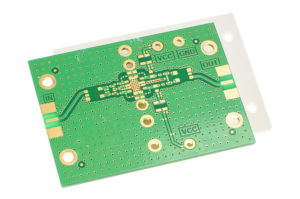
Developing a new electronic product requires speed, precision, and flexibility. Whether you’re designing a medical device, industrial controller, or consumer product, prototype PCB assembly plays a critical role in turning an idea into a working solution. By identifying design issues early and validating functionality before mass production, prototype assembly helps reduce costs and shorten development timelines.

Working with an experienced manufacturing partner allows engineers to test circuit designs quickly and make improvements before committing to larger production runs. Companies that invest in high-quality prototype builds often experience fewer delays and smoother transitions into full-scale manufacturing.

pcb-prototypePrototype PCB assembly is especially valuable during research and development because it enables rapid iteration. Engineers can evaluate performance, verify component placement, and confirm electrical functionality while minimizing the expense associated with redesigning large production batches.
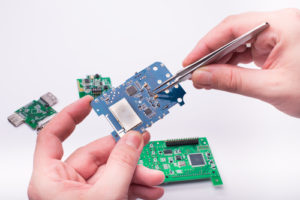
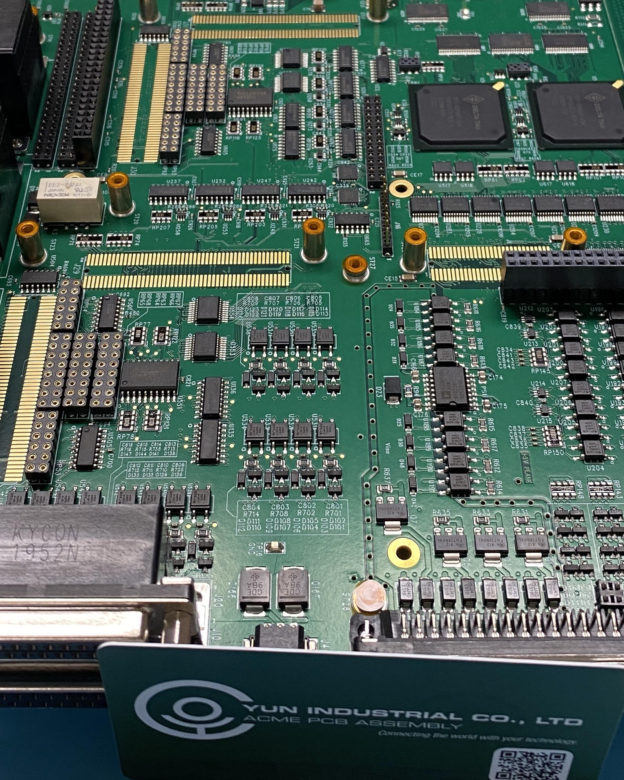
Another major advantage is improved communication between designers and manufacturers. Early collaboration helps identify manufacturability concerns that could otherwise lead to production issues later in the process. This proactive approach supports higher yields and more reliable finished products.

Businesses developing complex electronics can also benefit from prototype testing under real-world operating conditions. Environmental stress testing, performance validation, and compliance evaluations become easier when reliable prototypes are available for analysis.

When selecting a manufacturing partner, look for one that offers comprehensive support from prototype through production. Services such as component sourcing, design review, inspection, and quality assurance contribute to successful product launches and long-term reliability.

Board Assembly provides specialized prototype PCB assembly services designed to help customers validate designs efficiently. By combining engineering expertise with advanced manufacturing capabilities, projects can move from concept to production with greater confidence.

As products mature, manufacturers can seamlessly transition into additional services such as PCB fabrication and complete production assembly. Integrating these capabilities under one provider simplifies project management and helps maintain consistent quality standards throughout the manufacturing process.

For organizations seeking dependable electronic manufacturing solutions, partnering with an experienced provider can significantly improve development speed while reducing risk. Investing in prototype PCB assembly today often leads to better-performing products and more successful launches tomorrow.

Printed Circuit Board Fabrication

Printed Circuit Board Manufacturing vs. PCB Assembly: Understanding the Difference

There Are Differences Between Printed Circuit Board Manufacturing and Printed Circuit Board Assembly, But You Might Be Asking What Are They?

In the world of electronics, the terms Printed Circuit Board (PCB) Manufacturing and PCB Assembly are often used interchangeably—but they actually refer to two distinct processes. Understanding the difference is essential when choosing the right partner for your electronic product development.

At Yun Industrial / ACME PCB Assembly, we specialize in both PCB manufacturing and assembly services, ensuring customers receive complete, end-to-end solutions with unmatched quality and precision.

What Is PCB Manufacturing?

PCB manufacturing is the process of creating the physical printed circuit board from scratch. This involves several intricate steps, including:

  • Designing the board layout using CAD software

  • Creating a PCB prototype to test design accuracy

  • Layering copper and insulating materials to form conductive paths

  • Etching, drilling, and plating to create traces and vias

  • Applying solder masks and silkscreens for protection and labeling

Essentially, PCB manufacturing is about producing the bare board—the foundation that will later hold the electronic components. This stage requires high-precision machinery and engineering expertise to ensure the final board meets performance, safety, and durability standards.

What Is PCB Assembly?

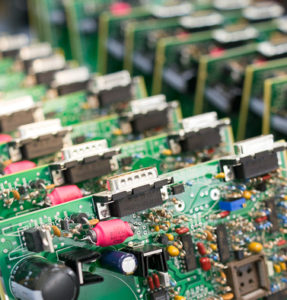
Once the bare board is manufactured, the next step is PCB assembly (PCBA). This is where the circuit board comes to life. The process involves soldering electronic components—such as resistors, capacitors, IC chips, and connectors—onto the PCB according to the design specifications.

PCB assembly can use Surface Mount Technology (SMT), Through-Hole Technology (THT), or a combination of both, depending on the application. This stage requires precise placement, temperature control, and soldering quality to ensure reliable electrical connections and functionality.

ACME PCB Assembly: Your One-Stop PCB Partner

At Yun Industrial ACME PCB Assembly, we provide both manufacturing and assembly services, eliminating the need to work with multiple vendors. As an ISO 9001:2015 certified Electronics Manufacturing Service (EMS) provider and IPC A-610 certified trainer, we uphold the highest industry standards for quality and reliability.

Every PCB we produce meets the strict guidelines of IPC 600, ensuring consistency, durability, and peak performance. Whether you need a prototype or large-scale production, ACME delivers the best value, competitive pricing, and on-time delivery—every time.

Contact us today to learn more about how ACME PCB Assembly can bring your next project from concept to completion.

Contact us today to learn more.

PCB Fabrication near me

Why Turnkey PCB Assembly Is the Ideal Solution for Modern Hardware Designers

For many entrepreneurs and manufacturers, traditional methods of electronics and printed circuit board (PCB) manufacturing can seem intimidating. Legacy manufacturing is often slow, error-prone, and expensive, which makes it difficult to move from concept to finished product. Historically, electronic assembly was designed for large batch runs and long lead times, leaving smaller orders and prototypes in a bind.

Today, however, turnkey PCB assembly has revolutionized the industry, making it faster, easier, and more cost-effective for hardware designers to bring their ideas to life. Let’s explore what makes turnkey PCB assembly such a game-changer and who can benefit from this modern approach.


Turnkey Yun IndustrialWhat Is Turnkey Printed Circuit Board Assembly?

Turnkey PCB assembly is a streamlined approach to electronic assembly that combines onshore PCB manufacturing with cloud-based software solutions. This synergy simplifies the entire process of developing and producing PCBs for entrepreneurs, engineers, and small businesses.

Unlike traditional methods that require coordinating multiple suppliers for components, assembly, and testing, turnkey PCB assembly consolidates all these steps under one roof. Some services even go beyond PCBs, providing full product assembly and record management, ensuring that your product is ready for market.


Who Can Benefit from Turnkey PCB Assembly?

One of the biggest advantages of turnkey PCB assembly is its accessibility. Here’s who stands to gain the most:

  • Startups and Small Businesses
    For companies just starting out, avoiding the high costs and risks of large inventories is crucial. Turnkey PCB assembly enables them to produce small quantities affordably, making it easier to test the market without financial strain.

  • Kickstarter and Crowdfunding Projects
    If you’re launching a product through a crowdfunding campaign, you may not know exactly how many boards you’ll need. Turnkey services give you the flexibility to produce just a few boards—or scale up quickly as demand grows.

  • Hobbyists and Makers
    Individual creators and small workshops benefit from the speed and convenience of instant PCB production. Whether you’re building a prototype or refining a new gadget, turnkey assembly makes it easy.

  • Engineers at Large Enterprises
    Even established companies can appreciate the faster turnaround times and simplified process compared to legacy manufacturing methods.


The ACME PCB Assembly Advantage

At ACME PCB Assembly, we pride ourselves on our high standards for efficiency, quality, and speed. Our turnkey supply chain management solutions and global network of resources enable us to handle projects of all sizes with precision and reliability.

📞 Contact us today to learn how our turnkey PCB assembly services can bring your electronic ideas to life—faster, more cost-effectively, and with fewer headaches.

smt technology chip

SMT Assembly Services for Precision and Speed

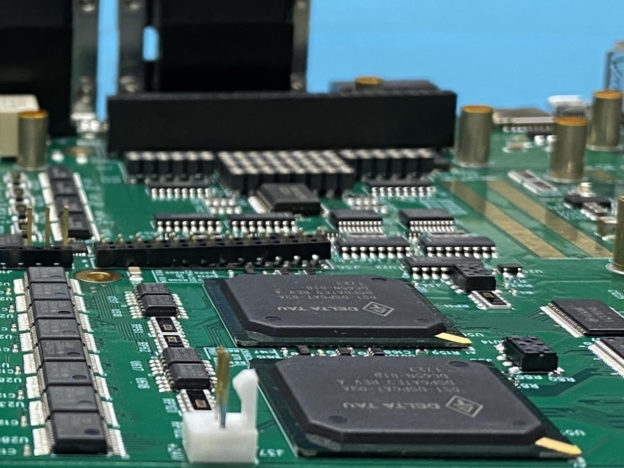
Surface Mount Technology (SMT) has transformed modern electronics manufacturing by enabling smaller, faster, and more reliable electronic devices. Instead of inserting components through drilled holes in a circuit board, SMT allows components to be mounted directly onto the surface of printed circuit boards (PCBs). This method significantly improves production efficiency while supporting the compact and complex designs required in today’s electronic products.

Professional SMT assembly services ensure that electronic components are placed accurately and securely onto PCBs using advanced automated equipment. High-speed pick-and-place machines precisely position thousands of components per hour, while automated soldering processes permanently bond them to the board. This level of precision allows manufacturers to produce high-density circuit boards with exceptional consistency and performance.

At Board Assembly, SMT assembly services are designed to deliver both speed and accuracy while maintaining strict quality control standards. The use of automated production lines allows for high-volume manufacturing without sacrificing reliability. This process supports the compact designs and multilayer circuit boards commonly used in industries such as consumer electronics, industrial automation, telecommunications, aerospace, and medical device manufacturing.

One of the major benefits of SMT assembly is improved electrical performance. Because surface-mounted components sit directly on the PCB rather than extending through it, signal paths are shorter and more efficient. This design reduces electrical resistance and improves signal integrity, which is especially important in high-speed electronic applications. In addition, SMT technology allows manufacturers to place components on both sides of a circuit board, maximizing available space and enabling more advanced functionality in smaller devices.

SMT assembly also increases manufacturing efficiency. Automated inspection systems, reflow soldering ovens, and precision component alignment significantly reduce human error and enhance repeatability. Automated Optical Inspection (AOI) systems verify component placement and solder joint quality, ensuring that each board meets strict production standards. When SMT assembly is integrated with in-house PCB fabrication, manufacturers benefit from a streamlined workflow that reduces production delays and improves overall project coordination.

Another important aspect of modern SMT assembly is compliance with lead-free assembly requirements. Environmental regulations such as RoHS (Restriction of Hazardous Substances) require electronics manufacturers to eliminate harmful materials like lead from their products. Lead-free soldering processes provide environmentally responsible manufacturing while maintaining strong mechanical connections and excellent electrical conductivity.

Advantages of SMT assembly include:

  • Higher component density for compact electronic designs

  • Improved reliability through automated precision placement

  • Faster production times with high-speed manufacturing equipment

  • Reduced manufacturing costs due to automation and efficiency

  • Enhanced signal performance for high-speed electronic circuits

For applications requiring additional protection, SMT assembly can be combined with conformal coating services. Conformal coating adds a protective layer over the assembled PCB to guard against moisture, dust, chemicals, and environmental contaminants. This combination ensures that electronic assemblies remain durable and reliable even in harsh operating environments.

Choosing an experienced SMT assembly partner ensures consistent quality and scalability throughout the manufacturing process. From prototype development to high-volume production, advanced automation and rigorous inspection procedures support precise component placement and long-lasting solder integrity.

By integrating PCB fabrication, SMT assembly, testing, and protective coatings under one roof, Board Assembly provides manufacturers with a complete electronics manufacturing solution designed for performance, efficiency, and long-term reliability.

Solder Mask on Printed Circuit Boards

Custom PCB Fabrication for High-Performance Electronics

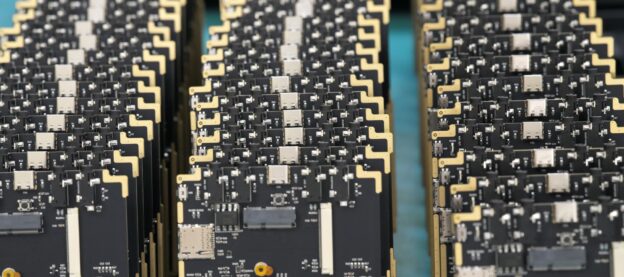
Quality PCB fabrication is the foundation of reliable electronic products. Without precise printed circuit board manufacturing, even the most advanced electronic designs can fail in real-world applications. Professional PCB fabrication ensures that copper traces, vias, and multiple circuit layers are produced to exact specifications, allowing electronic systems to operate efficiently and consistently. Precision manufacturing directly impacts electrical performance, durability, and the long-term reliability of modern electronics.

PCB layout and circuitry designBoard Assembly provides comprehensive PCB fabrication services designed to meet the increasing demands of today’s electronics industry. Many advanced devices require multilayer circuit boards, tight manufacturing tolerances, and high-density interconnects to support compact designs and complex functionality. From early-stage prototypes to full-scale production runs, precision PCB fabrication plays a critical role in ensuring products meet both performance expectations and industry compliance standards.

High-quality PCB fabrication influences every stage of the electronics product lifecycle. During the design and manufacturing process, careful material selection ensures that circuit boards can withstand thermal stress, electrical load, and environmental conditions. Engineers must also carefully plan the layer stack-up, which determines how signal, power, and ground layers interact within the board. This structure directly affects signal integrity, electromagnetic compatibility, and heat dissipation. Controlled impedance routing is another essential element, particularly for high-speed applications such as telecommunications equipment, computing systems, and industrial automation.

Advanced PCB fabrication techniques allow manufacturers to produce increasingly smaller and more powerful electronic devices. As products become more compact, circuit boards must support miniaturization and high component density without sacrificing reliability. Technologies such as microvias, fine-line circuitry, and multilayer board construction make it possible to pack more functionality into smaller spaces. These innovations are critical for industries that depend on high-performance electronics, including aerospace, automotive electronics, medical devices, and consumer technology.

When PCB fabrication is combined with SMT assembly and lead-free assembly processes, manufacturers gain a streamlined production workflow that improves efficiency and quality control. Working with a single provider for fabrication and assembly reduces communication errors between vendors and shortens production timelines. Integrated manufacturing also ensures strict adherence to quality standards throughout the entire production cycle, from bare board fabrication to final component placement and inspection.

Benefits of custom PCB fabrication include:

  • Accurate layer alignment for consistent circuit performance

  • High conductivity and reliable electrical connections

  • Improved signal integrity for high-speed electronic applications

  • Enhanced durability under thermal and mechanical stress

  • Reduced manufacturing defects and improved product reliability

Industries such as telecommunications, automotive, aerospace, and medical electronics depend on precision PCB fabrication to meet strict regulatory and safety standards. Circuit boards used in these environments must withstand vibration, temperature fluctuations, and electrical stress while maintaining stable performance over time.

Partnering with an experienced PCB fabrication provider ensures consistency from design through final assembly. By integrating fabrication with testing, inspection, and quality assurance, Board Assembly supports customers with scalable manufacturing solutions tailored to demanding performance requirements. Whether developing prototypes or producing high-volume electronics, professional PCB fabrication helps ensure products perform reliably in today’s increasingly complex technological landscape.